A Digital Portfolio of Your Learning

Erica Kempster

Month: November 2026

Week 9 Learning Reflection – Prince George Public Library

This week our class was held at the Prince George Public Library. It was interesting visiting the public library because I used to go to the public library a lot when I was a kid, but I haven’t been there in many years. I used to always be excited to go explore new books with my mom and my sister, and it was a great community hub for us as kids! Visiting the public library brought back many positive memories, and made me inclined to start visiting the public library more often as they have so much to offer. Throughout our tour of the public library, I was surprised to see how many books they had for all different ages, and was interested to learn about the many other resources that they offer, such as kits and board games, as well as free tutoring, study rooms, computers, and library tours. It was very helpful to learn about these many resources that they offer, and to think about how these resources can be utilized specifically by teachers. I would love to take my future students to the public library to explore what they have to offer, as well as share the many opportunities for students, such as workshops and free tutoring. One resource that specifically interested me was the story kits for educators. Educators can pick a story kit topic, as well as specific age/grade, and the PGPL will put together a story kit full of books, felts, puppets, CDs, and more to support educational and interactive story time. This resource in particular is one that I would love to use in the future!

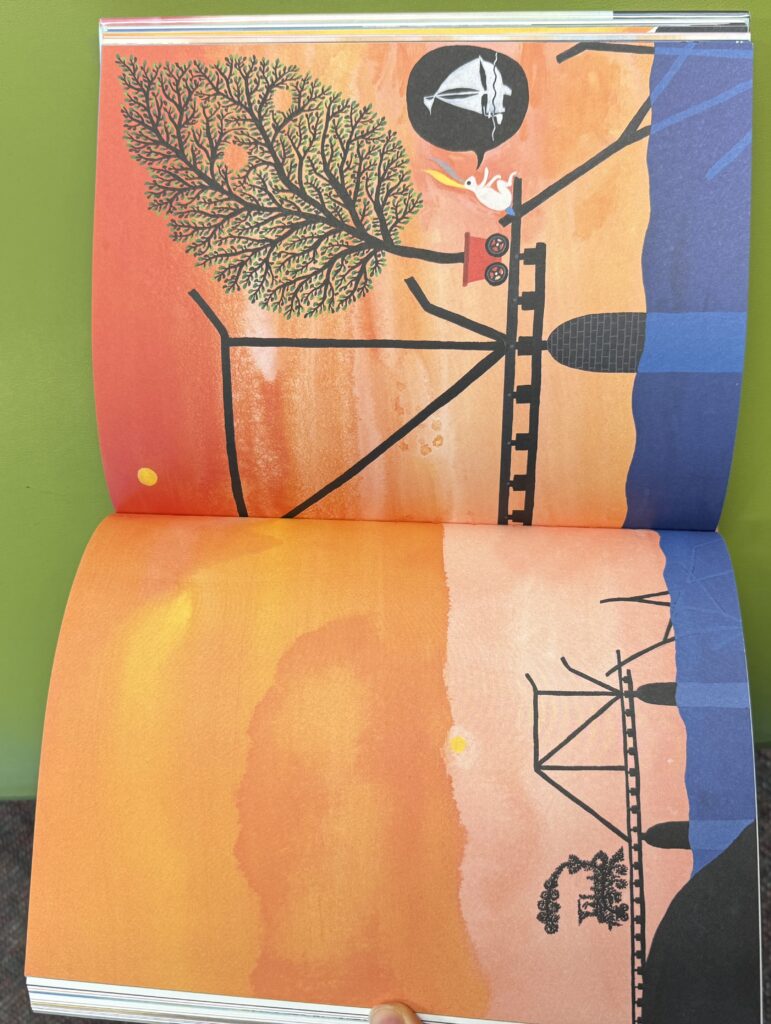
            During our time at the public library, we also explored different learning resources that could be useful for our lesson plans that we developed at Cottonwood Island Park. We discovered a plethora of learning resources throughout the public library, and it was very educational to think about how our lesson could have cross-curricular connections, as well as how it could be scaffolded across multiple lessons. The learning resource that we chose to use is a wordless picture book, which depicts many features, including a bunny. We thought that this book was really neat because it allows for creativity and imagination, and connects to our Cottonwood Island Park lesson plan about story creation and the land. I am looking forward to exploring more learning resources, and incorporating the PGPL resources into my future classroom and teaching career.

Here is an image from the book to get an idea of how this wordless story has lots to say!

Zsako, B. (2023). Bunny & Tree. Enchanted Lion Books.
Week 8 Learning Reflection – RJay Berra and Standard 2

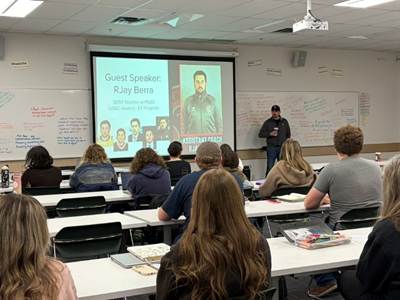
This week we had the privilege to learn from RJay Berra, a UNBC Alumni of the BEd program, and a SD57 teacher at PGSS. It was super helpful to ask him questions and advice on the education program, practicums, teaching, work-life balance, and more. One of the main points that I took away from his advice is the importance of positive student/teacher relationships. RJay articulated how important it is to built a supportive, caring, and encouraging classroom environment where students feel valued, and meaningful connections are fostered. He also focused on the importance of student-centered learning, and how incorporating student’s passions and interests, as well as your own passions and interests, can increase student engagement, and is an opportunity to meet student’s individual needs. Another significant point that RJay mentioned is owning your own mistakes. Modeling honesty and accountability as a teacher is impactful because students need to learn that everyone makes mistakes, which it totally normal and does not automatically mean failure, and the importance of leading with honesty, as well as how to be accountable for our actions. As the teacher, you are setting the standard. It is important to model positive behavior, keep open and honest communication, and make decisions for the betterment of your students. Every class/group of students will be different and have differing needs, meaning that the decisions based upon the “betterment of your students” will change. This points to the importance of enacting adaptability.

Everything that RJay shared with our class embodied the BCTF Standard 2: “Educators act ethically and maintain the integrity, credibility and reputations of the profession” (British Columbia Teachers’ Council, 2019, Standard 2). RJay articulated the importance of educators being role models by modeling honesty, accountability, and open-communication, and building a positive and supportive student-centered classroom environment. It became apparent that RJay models Standard 2 throughout his career as he explained how being a positive role model for his students has been a huge benefit, for himself, as well as his students. Educators should be held at a high standard, and this standard should be set by the teacher through mutual respect, and being a role model of positive behavior. I learned a lot throughout this class, and am thankful for RJay’s input and advice.

Reference: British Columbia Teachers’ Council. (2019). Professional standards for BC educators. Government of British Columbia. edu_standards.pdf

Here is a photo from the presentation:

Week 7 Learning Reflection – ARC-BC

This week we learned about accessible digital books through a presentation by Victoria Woelders, from the Accessible Resource Centre of British Columbia (ARC-BC). This presentation was very interesting and educational because I had no clue that these awesome resources existed! We learned that ARC-BC creates accessible digital books, mostly from novels and textbooks, for students with perceptual disabilities. Novels and textbooks are made into brail books, audio books, and color-blind friendly books. Creating these accessible resources for students is huge in their learning journey! I also learned that ARC-BC translates books into different languages, including Indigenous languages. It is really helpful to learn about these different resources to be able to support each student with individual needs, and make the world an easier place to learn for diverse students.

            I also learned a lot from this week’s Ted Talk video, Under the Table – The Importance of Presuming Competence, presented by Shelley Moore, because it was a very educational video on inclusive education. I do agree that it is super important to learn students’ individual needs, interests, and abilities, and how to support them in their learning journey. I also think that it is very important to believe in students, and change the “I can’t” narrative, because every student is capable of succeeding in learning, with the right tools and supports. The main thing that I took away from Shelley Moore’s talk is that students have a lot to teach us, and we, as teachers, have a lot to learn from each student.

            This week’s reading, “Assessment of Learning, for Learning, and as Learning” (Earl, 2003), was also very educational because, I have learned about summative and formative assessment before, but I have not thought about the different ‘uses’ of assessment. I learned that assessment of learning is the predominant form of assessment, generally in the form of tests or exams, and is used to report to students and parents, producing a rank among the students. Assessment for learning is formative, and is used for scaffolding the next steps in learning, while highlighting the student’s strengths and stretches. Lastly, assessment as learning is described as “the ultimate goal, where students are their own best assessors” (Earl, 2003, p. 5), and where students have the opportunity to make their own judgements. It was important that the author pointed out how all of these approaches to assessment are applicable, but finding balance between them is what is most important.

Earl, L. M. (2003). Assessment of learning, for learning, and as learning. In Assessment as learning: Using classroom assessment to maximize student learning (pp. 21–28). Corwin Press.

TEDxTalks (2016, March 11th). Under the Table – The Importance of Presuming Competence [Video]. YouTube. https://www.youtube.com/watch?v=AGptAXTV7m0

Powered by WordPress & Theme by Anders Norén