
Erica Kempster

A Digital Portfolio of Your Learning

Erica Kempster

Week 4 Learning Reflection – West Lake

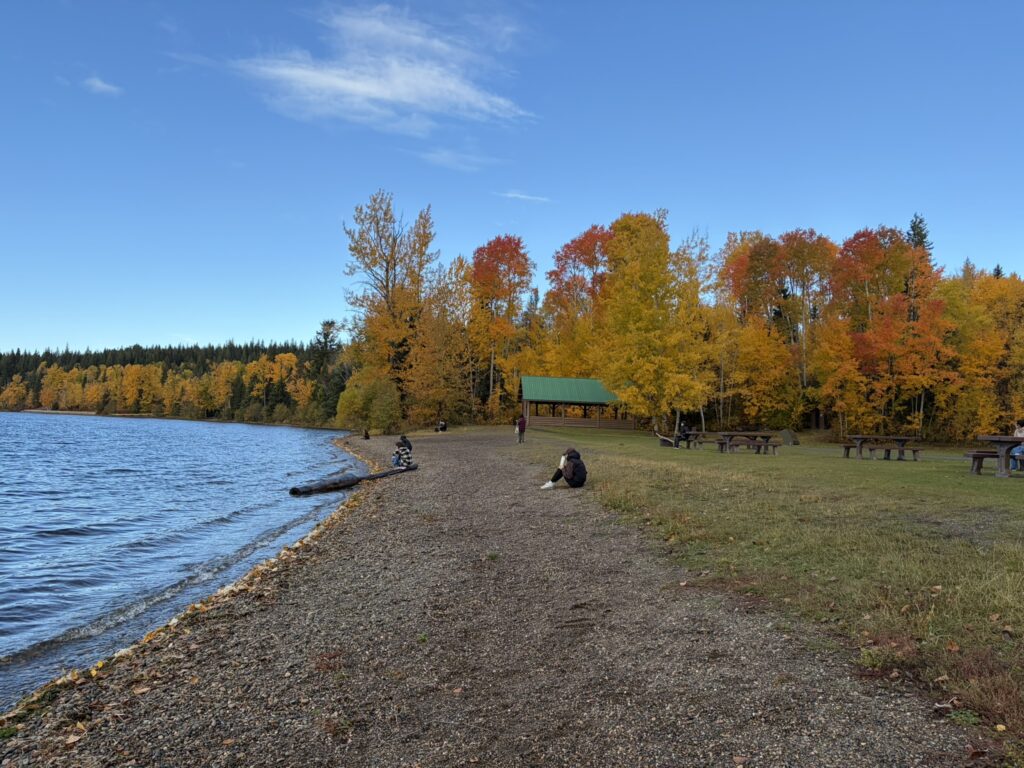
Reflecting on our class time at West Lake, I really enjoyed being out on the land to participate in land-based learning. It was refreshing to feel the fall air, and learn outside of the walls of the classroom. Participating in land-based learning activities makes me more inclined to incorporate land-based learning into my teaching career, and gives us practical lesson ideas, such as the walking curriculum. I noticed how much more observant I became of the environment around me during the walking curriculum, and I was able to deeply explore the changing season surrounding us. I noticed how soft the bright colored leaves were on the birch tree, and was taken aback by the deep red, orange, and yellow leaves, ready to fall.

Here is a picture that Christine took of the beautiful fall trees!
      Another reflection that I have from our West Lake experience is the discussions that we had around land acknowledgements. Through reflection on my connection to people, place, and land, I focused on my gratefulness for the land, when thinking of personal land acknowledgements. I spend a lot of time on the land, whether that be hiking, skiing, hunting, or star-gazing, and I have realized that it is easy to take the land for granted if I do not allow myself time for reflection and gratitude. I am very grateful to be on the traditional lands of the Lheidli T’enneh first nation, and am very appreciative for everything that the land provides for me, such as joyful experiences, adventure, and animals to feed my family. It is vital that I continue to take care of and give back to the land as fostering this reciprocal relationship is my responsibility as a visitor on this beautiful traditional territory.

      I would also like to reflect on the Four R’s that we learned about through Kirkness & Barnhardt’s article: First Nations and Higher Education: The Four R’s – Respect, Relevance, Reciprocity, Responsibility. The Four R’s exemplify what we, as educators, need to keep in the forefront of our minds as education should model these principals in order to promote inclusivity, diversity, and holism. I have learned through this article that education should be more than just checking boxes in order to get a higher paying job, and should not draw students away from who they are. This article on the Four R’s has sparked a lot of reflection for me, especially of my own education journey, as I have seen education as a stepping stone in gaining more opportunities and higher paying jobs, which has, in turn, drawn me away from who I am. I am realizing the importance of holism in education, and am wanting to change this ‘box-checking’ narrative for my future students, as the well-being of each individual student is valuable.

Kirkness, V. J., and Barnhardt, R. (1991). First Nations and Higher Education: The Four R’s – Respect, Relevance, Reciprocity, Responsibility. Journal of American Indian Education, 30(3), 1-15. http://www.jstor.org/stable/24397980
Week 3 Learning Reflection

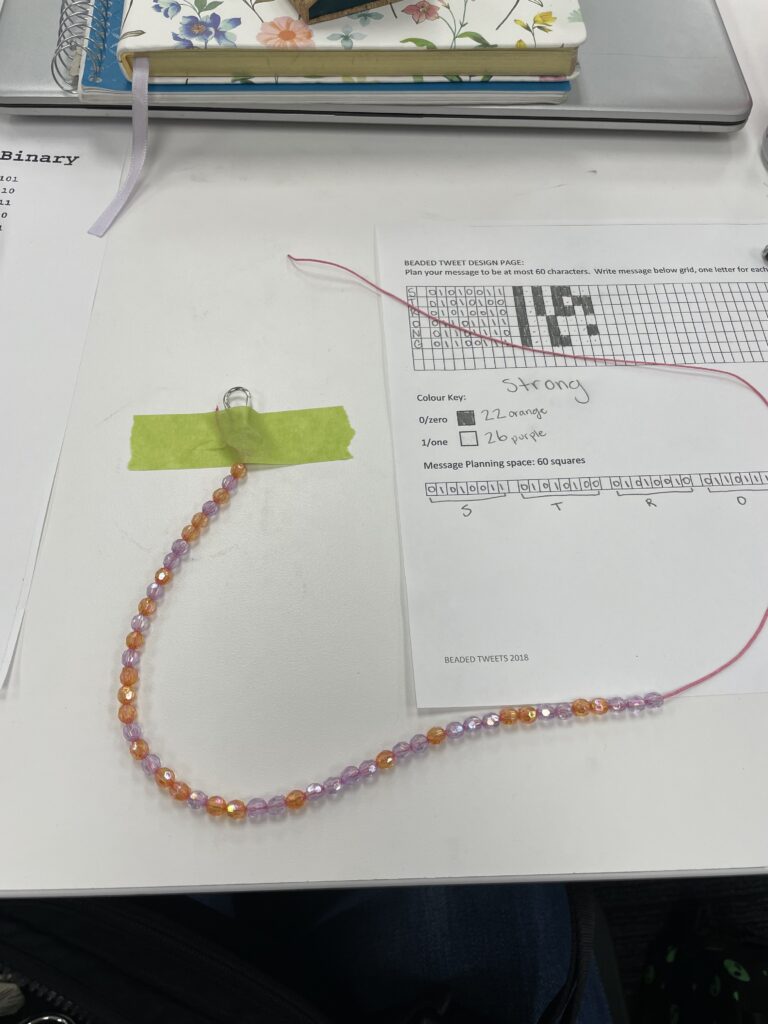
This week we had the great opportunity to learn about Beaded Tweets with Noelle Pepin. It was very interesting to learn about the coding, as well as how this coding can be used in beading to incorporate Indigenous content into the classroom. One thing that I took away from this experience is how relaxing and grounding beading is. It really made me focus, think deeply, check that I was bringing positive energy into this activity, and made me deeply appreciate the beautiful bead work that many talented people do. The beaded tweet key chain that I made was coded to say “strong”, and I made it for my sister. This was a moment of deep reflection and gratitude for me as I look up to my sister immensely because of her emotional and mental strength, and the way that she cares deeply for others on a daily basis.

Reflecting on Indigenous perspectives and knowledge in BC’s Curriculum, including the Professional Standard 9, encompasses the importance of including, valuing, and respecting the integration of Indigenous worldviews and perspectives into the learning environment. I have also learned that this means that, as educators, we must acknowledge our own biases as teaching holds a mirror to one’s own identity, beliefs, and biases. This is important in order to facilitate positive learning and change. I find it challenging sometimes to think of how to actively incorporate Indigenous perspectives and knowledge into the learning environment, specifically for subjects such as math. Although, learning about educational activities, such as the Beaded Tweets, gives me much hope towards the integration of Indigenous perspectives and knowledge into the classroom as this activity in particular was a great academic tool for focusing and counting, while also making me reflect, slow down, and learn more about Indigenous ways of knowing and being. These learning moments that I have experienced this week will impact my future teaching career because I am becoming more and more passionate about finding different ways to incorporate Indigenous perspectives and knowledge into the classroom, such as through the Beaded Tweets activity.

About Your Posts

Blog posts are formative and used for self-reflection.

Most of the resources in this e-portfolio are arranged in [Pages].  This entry is a [Post]. So DO NOT “edit” the page. Add a “new” post instead.

Some of the key differences between posts and pages are:

  • Posts are timely content part of a series of posts in a blog. Pages are static documents which are not tied to the blog’s reverse chronological order of content
  • Pages can be hierarchical, which means a page can have sub pages, for example a parent page titled “About us” can have a sub-page called “Our history”. On the other hand posts are not hierarchical.
  • By default posts in WordPress can be sorted into taxonomies Categories and Tags. Pages do not have categories or tags.
  • WordPress posts are displayed in RSS feeds while Pages are excluded from feeds.

Posts are a great way to record short reflections on a particular topic.  When you are ready to start adding posts to your ePortfolio delete this post and add your own.

In EDUC 394, we will be engaged in regular weekly reflections. Some learning experiences maybe prompted for the Professional Standards webpages, but learning that happened during each week, whether it be a reading, small group discussion, guest speaker, class-wide learning experience, etc., you can choose what learning had impacted or made an impression on you and your future practice as a K-12 educator.

Formative assessment means… to form and inform learning… so consider blog posts as an opportunity to use the e-portfolio platform and writing to reflect, sense-make, and wonder. The focus remains on your learning within EDUC 394 and the UNBC Teacher Education Program.

Success Criteria:

  1. A weekly 300-500 word reflection on the learning in EDUC 394.
  2. Describe the experience, what did you learn, and why it matters.
  3. Add an image, link, or quote to complement the text.
  4. Be compliant to the Professional Standards for BC Educators.

Powered by WordPress & Theme by Anders Norén