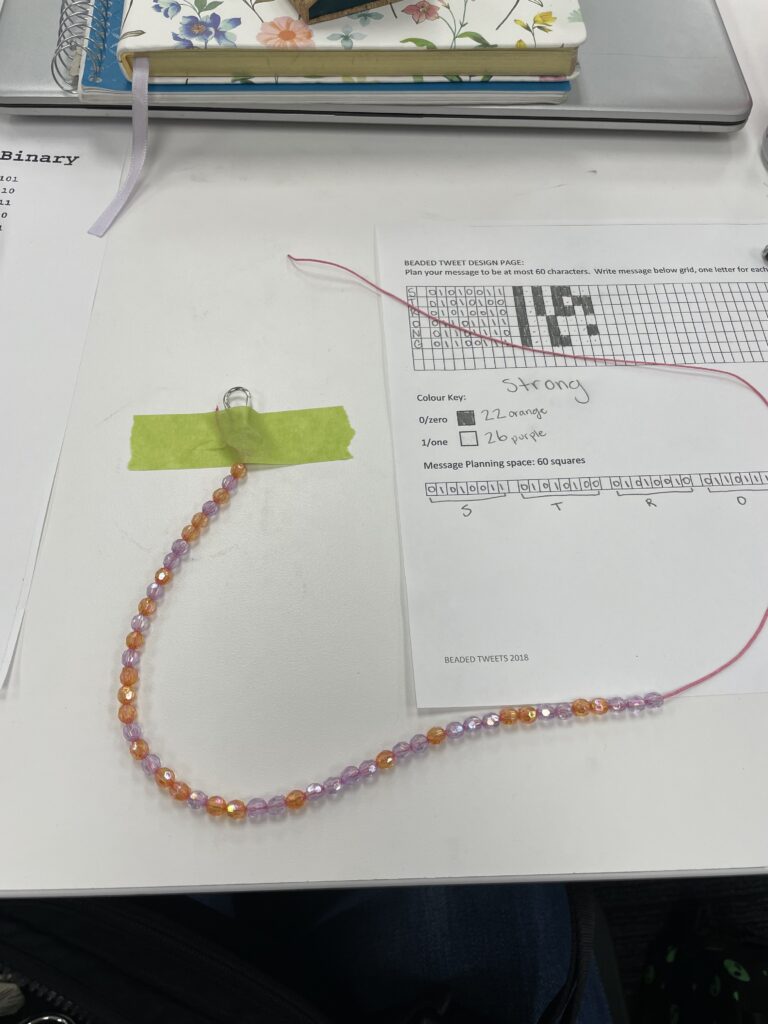
This week we had the great opportunity to learn about Beaded Tweets with Noelle Pepin. It was very interesting to learn about the coding, as well as how this coding can be used in beading to incorporate Indigenous content into the classroom. One thing that I took away from this experience is how relaxing and grounding beading is. It really made me focus, think deeply, check that I was bringing positive energy into this activity, and made me deeply appreciate the beautiful bead work that many talented people do. The beaded tweet key chain that I made was coded to say “strong”, and I made it for my sister. This was a moment of deep reflection and gratitude for me as I look up to my sister immensely because of her emotional and mental strength, and the way that she cares deeply for others on a daily basis.
Reflecting on Indigenous perspectives and knowledge in BC’s Curriculum, including the Professional Standard 9, encompasses the importance of including, valuing, and respecting the integration of Indigenous worldviews and perspectives into the learning environment. I have also learned that this means that, as educators, we must acknowledge our own biases as teaching holds a mirror to one’s own identity, beliefs, and biases. This is important in order to facilitate positive learning and change. I find it challenging sometimes to think of how to actively incorporate Indigenous perspectives and knowledge into the learning environment, specifically for subjects such as math. Although, learning about educational activities, such as the Beaded Tweets, gives me much hope towards the integration of Indigenous perspectives and knowledge into the classroom as this activity in particular was a great academic tool for focusing and counting, while also making me reflect, slow down, and learn more about Indigenous ways of knowing and being. These learning moments that I have experienced this week will impact my future teaching career because I am becoming more and more passionate about finding different ways to incorporate Indigenous perspectives and knowledge into the classroom, such as through the Beaded Tweets activity.